The expensive lie hiding inside the obvious problem
Start with the sentence that usually gets skipped: this is not financial advice, and no trading community can remove market risk. That caveat is not a legal speed bump. It is the honest frame for the whole decision. If the buyer needs certainty, the correct answer is not a better sales page. The correct answer is to avoid trading until risk is understood. Jdub Trades should be evaluated as a structured education and community environment, not as a machine that turns attention into guaranteed money.
The surface desire is simple. The market-open trader who wants live context without renting someone else's conviction wants better trades, clearer reads, and fewer mistakes. But the deeper desire is more specific. They want the moment before the click to feel less chaotic. They want a room where an idea is explained, a mistake can be reviewed, and the same process can be repeated enough times to become familiar. That is a more grounded promise than the lazy claim that a room can make anyone profitable.
The wrong belief is: Watching a live trader automatically makes you a better trader. It is attractive because it reduces the work of judgment. If the room is active, the trader feels less alone. If the coach sounds certain, the setup feels safer. If other members are excited, the hesitation feels like proof that the buyer is missing out. None of that is the same as a process. Activity can disguise confusion. Certainty can be borrowed. Excitement can push a trader into size they did not plan.
the watch-log-review loop
The better buying question
The better belief is: A live session becomes education only when you arrive with a question, track the read, and review what changed. Read that line slowly. It changes what the offer has to prove. The question stops being "will this tell me what to buy?" and becomes "will this help me prepare, understand, act, and review better than I do alone?" That is a higher-quality buying question because it gives the member a way to judge the membership after the first week without pretending one green trade settles the matter.
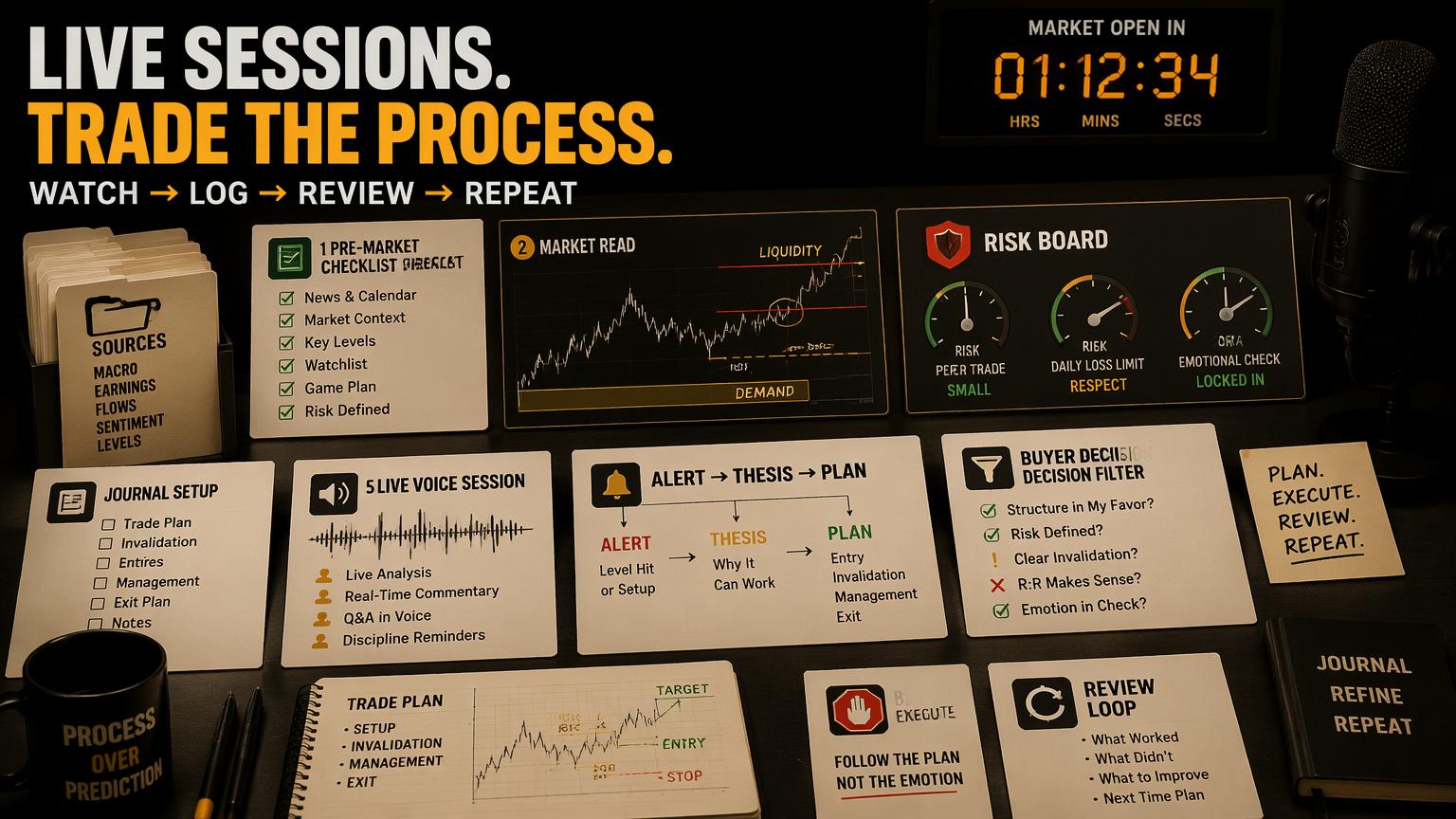
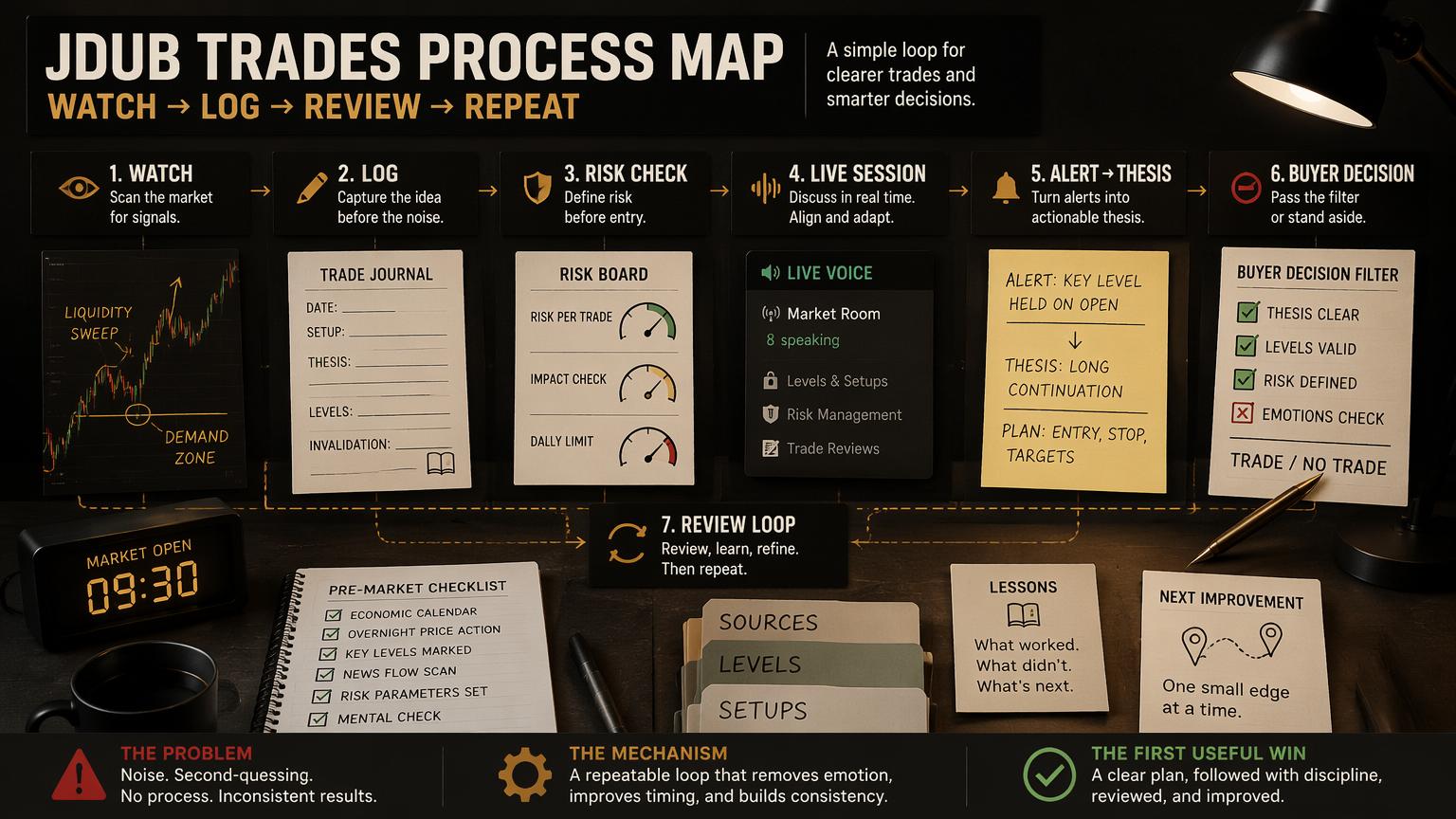
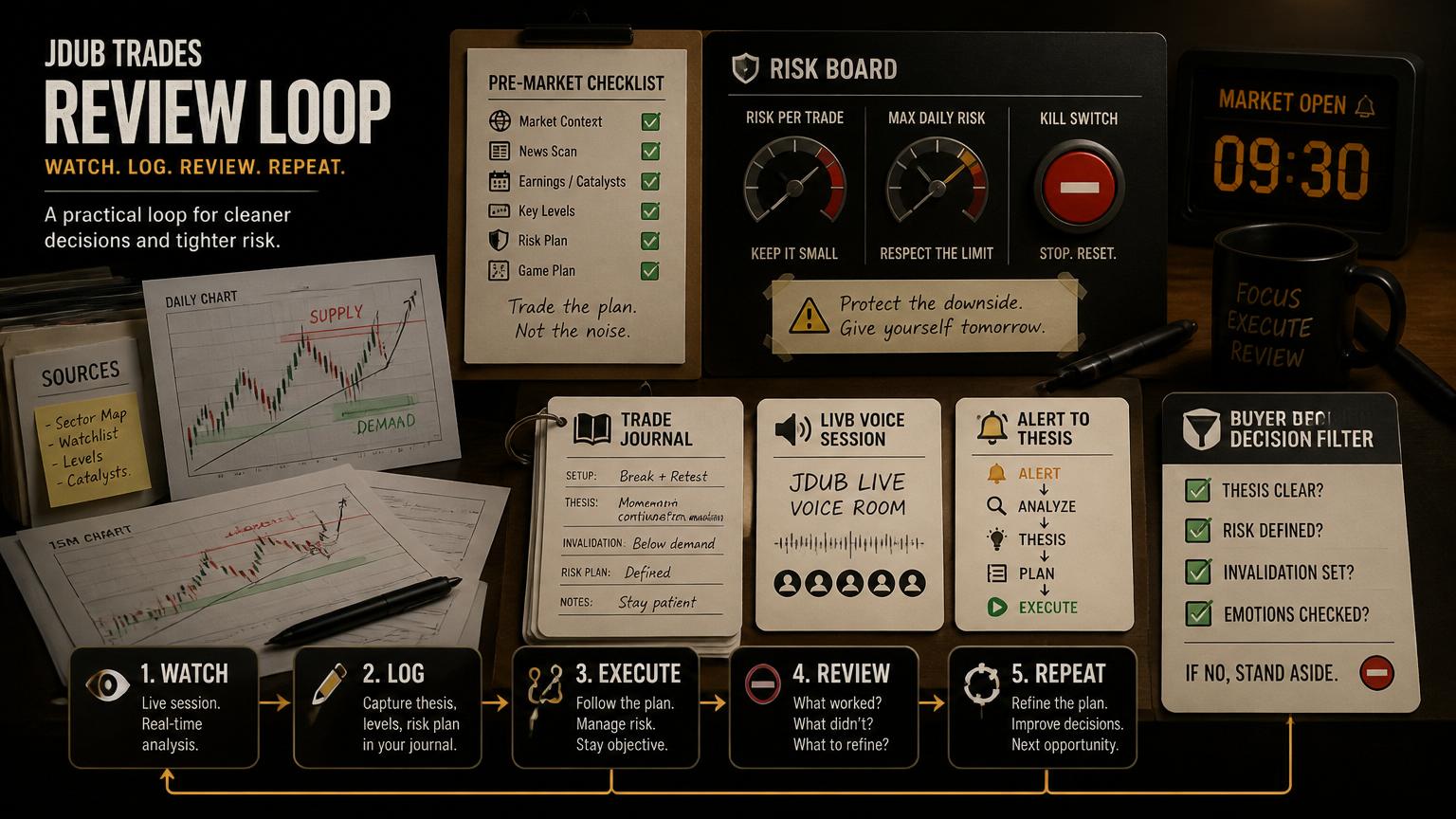
The mechanism is the watch-log-review loop. That phrase matters because it turns the offer from a pile of features into a machine. A course gives language. A live session gives context. Alerts give examples. Reviews give correction. Discord gives accountability and pattern recognition. The membership is strongest when those parts feed each other. The course informs the live read. The live read creates examples. The examples go into the journal. The journal creates better questions for the next session.
This is where the Value Equation becomes useful. The dream outcome is not "get rich from signals." That claim would be both irresponsible and unbelievable. The dream outcome is a trader who becomes more deliberate: fewer random entries, cleaner risk language, better preparation, and a clearer review path. Perceived likelihood rises when the buyer can see the process. Time delay shrinks when the first result is clarity instead of a promised payout. Effort drops when the routine tells the trader what to do before, during, and after the session.
| Question | Weak use | Strong use |
|---|---|---|
| live room usage | Use the room as a shortcut around thinking. | Use the room to sharpen the question you bring to the chart. |
| Alert | Treat the entry as permission. | Translate the idea into thesis, size, risk, and exit. |
| Live session | Wait for someone to sound certain. | Track what changed from pre-market plan to live context. |
| Review | Save screenshots and move on. | Name the decision error and the correction for next time. |
| CTA | Buy because you feel behind. | Join only if the routine can change this week. |
How the value equation applies without hype
Notice how restrained the claim becomes. The page does not need to say the market is easy. It can say the market is easier to study when the room has a rhythm. It does not need to promise a win rate. It can say a written invalidation protects the trader from inventing one under pressure. It does not need to shame the buyer for being emotional. It can show how emotion enters when the plan is missing. Strong copy does not remove the risk disclosure. Strong copy makes the disclosure part of the trust.
The first useful win is this: you know what to write down before the first setup is discussed. That is intentionally smaller than a profit claim. It is also more realistic. A trader can know, on day one, whether the onboarding makes sense, whether the live-room rhythm is clear, whether the course path is visible, and whether the community feels like a place for questions or just noise. Those are inspectable signals. They do not guarantee future results, but they do tell the buyer whether the environment is built for learning or merely excitement.
The deeper story is not about one trade. It is about the same trade happening again in different clothes. One week it is a late call entry. The next week it is a put that should have been skipped. The week after that it is a revenge trade after a clean loss. On the surface, the tickers change. Underneath, the pattern is the same: unclear thesis, loose size, emotional management, weak review. A room becomes valuable only if it helps the trader identify that buried pattern.
The numbers are illustrative friction scores, not performance claims. The point is the direction: make the decision surface cleaner before the trade gets emotional.
The seven-layer trading story
- The chart moves.
- You feel late.
- You borrow conviction.
- Risk becomes an afterthought.
- The trade becomes personal.
- The review gets skipped.
- The same pattern returns next week.
This is why you join the room, hear the idea, enter late, and then discover you never understood the invalidation. The pain is not merely financial. It is cognitive. The trader starts to mistrust their own judgment because every decision feels like it was made by a different version of themselves. Calm-at-night trader writes the rule. Market-open trader breaks it. Post-loss trader explains it away. A good process forces those three versions into the same notebook.
A responsible buyer should also ask what the offer cannot do. It cannot place risk for you. It cannot make you follow a stop. It cannot turn a fast market into a slow one. It cannot make copied conviction durable. It cannot guarantee that any alert will fit your account size, time zone, strategy, broker, or emotional tolerance. These limitations are not reasons to dismiss the offer. They are reasons to use it correctly.
The one-week audit
The practical test is simple. Before joining, write down the behavior you want changed. Do not write "make more money." Write the observable behavior: I want to stop entering late. I want to define risk before entry. I want to review every trade the same day. I want to ask better questions in a live room. I want to stop switching strategies after every red morning. If you cannot name the behavior, the membership has no fair target to hit.
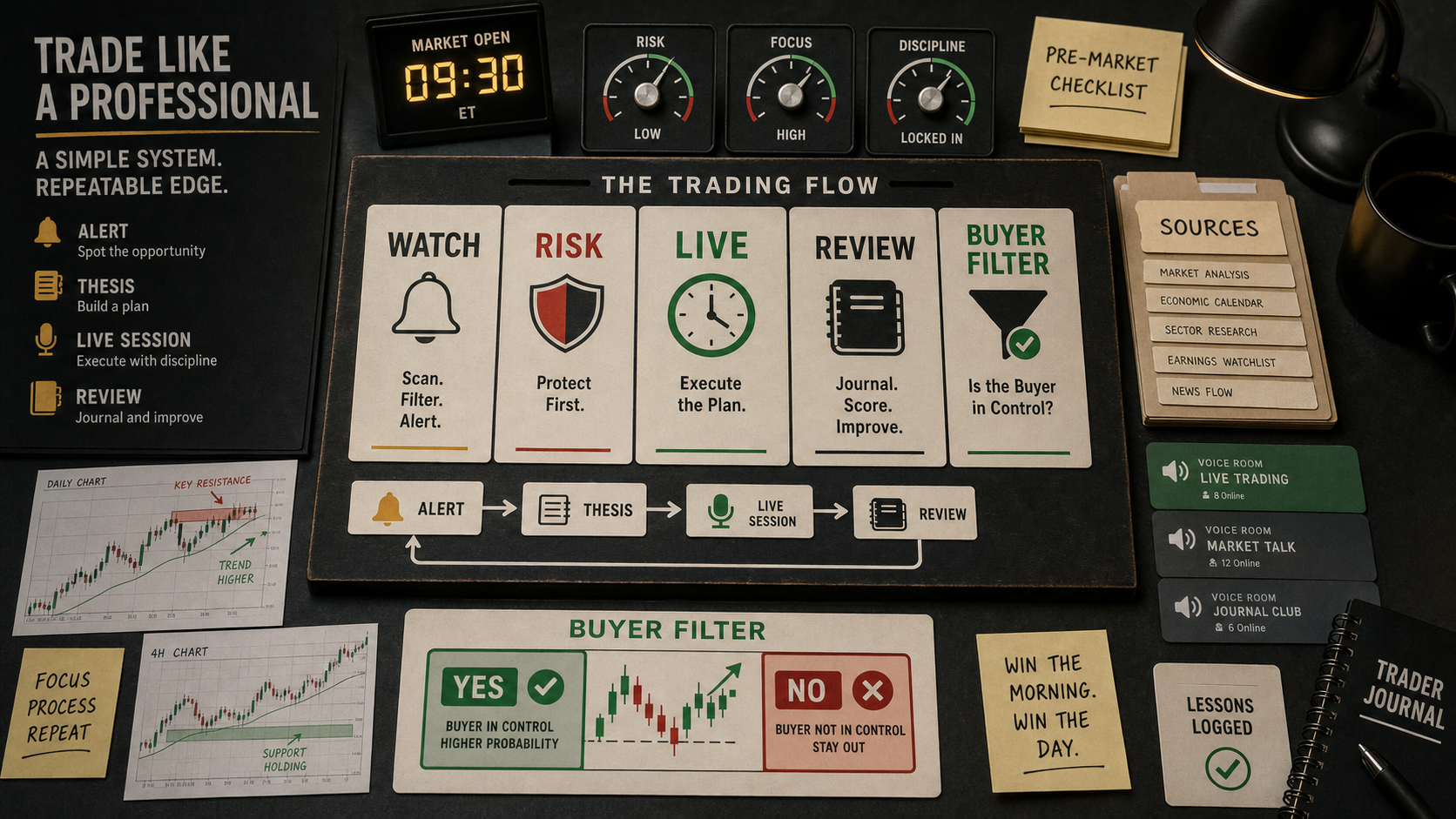
Then build a one-week audit. On day one, inspect the course path and community structure. On day two, watch the live session with a note template. On day three, translate one discussed idea into your own thesis without taking it. On day four, compare your pre-market plan to what actually happened. On day five, review one mistake with the five-field card. The question at the end is not "did I get rich?" The question is "did this environment improve the way I think?"
The CTA belongs after that audit, not before it. If the answer is yes, open the Whop page and decide whether Premium fits your routine, schedule, and risk tolerance. If the answer is no, do not buy from fear of missing out. The right buyer is not the person who needs pressure to click. The right buyer is the person who sees the mechanism, understands the limits, and wants a more structured trading day.
the watch-log-review loop
Disclosure: trading involves risk. This article is educational, includes an affiliate link, and does not promise profit, win rate, or typical results.
Deeper buyer notes: the watch-log-review loop
Start with the sentence that usually gets skipped: this is not financial advice, and no trading community can remove market risk. That caveat is not a legal speed bump. It is the honest frame for the whole decision. If the buyer needs certainty, the correct answer is not a better sales page. The correct answer is to avoid trading until risk is understood. Jdub Trades should be evaluated as a structured education and community environment, not as a machine that turns attention into guaranteed money.
The surface desire is simple. The market-open trader who wants live context without renting someone else's conviction wants better trades, clearer reads, and fewer mistakes. But the deeper desire is more specific. They want the moment before the click to feel less chaotic. They want a room where an idea is explained, a mistake can be reviewed, and the same process can be repeated enough times to become familiar. That is a more grounded promise than the lazy claim that a room can make anyone profitable.
The wrong belief is: Watching a live trader automatically makes you a better trader. It is attractive because it reduces the work of judgment. If the room is active, the trader feels less alone. If the coach sounds certain, the setup feels safer. If other members are excited, the hesitation feels like proof that the buyer is missing out. None of that is the same as a process. Activity can disguise confusion. Certainty can be borrowed. Excitement can push a trader into size they did not plan.
The better belief is: A live session becomes education only when you arrive with a question, track the read, and review what changed. Read that line slowly. It changes what the offer has to prove. The question stops being "will this tell me what to buy?" and becomes "will this help me prepare, understand, act, and review better than I do alone?" That is a higher-quality buying question because it gives the member a way to judge the membership after the first week without pretending one green trade settles the matter.
The mechanism is the watch-log-review loop. That phrase matters because it turns the offer from a pile of features into a machine. A course gives language. A live session gives context. Alerts give examples. Reviews give correction. Discord gives accountability and pattern recognition. The membership is strongest when those parts feed each other. The course informs the live read. The live read creates examples. The examples go into the journal. The journal creates better questions for the next session.
This is where the Value Equation becomes useful. The dream outcome is not "get rich from signals." That claim would be both irresponsible and unbelievable. The dream outcome is a trader who becomes more deliberate: fewer random entries, cleaner risk language, better preparation, and a clearer review path. Perceived likelihood rises when the buyer can see the process. Time delay shrinks when the first result is clarity instead of a promised payout. Effort drops when the routine tells the trader what to do before, during, and after the session.
Notice how restrained the claim becomes. The page does not need to say the market is easy. It can say the market is easier to study when the room has a rhythm. It does not need to promise a win rate. It can say a written invalidation protects the trader from inventing one under pressure. It does not need to shame the buyer for being emotional. It can show how emotion enters when the plan is missing. Strong copy does not remove the risk disclosure. Strong copy makes the disclosure part of the trust.
The first useful win is this: you know what to write down before the first setup is discussed. That is intentionally smaller than a profit claim. It is also more realistic. A trader can know, on day one, whether the onboarding makes sense, whether the live-room rhythm is clear, whether the course path is visible, and whether the community feels like a place for questions or just noise. Those are inspectable signals. They do not guarantee future results, but they do tell the buyer whether the environment is built for learning or merely excitement.
The deeper story is not about one trade. It is about the same trade happening again in different clothes. One week it is a late call entry. The next week it is a put that should have been skipped. The week after that it is a revenge trade after a clean loss. On the surface, the tickers change. Underneath, the pattern is the same: unclear thesis, loose size, emotional management, weak review. A room becomes valuable only if it helps the trader identify that buried pattern.
This is why you join the room, hear the idea, enter late, and then discover you never understood the invalidation. The pain is not merely financial. It is cognitive. The trader starts to mistrust their own judgment because every decision feels like it was made by a different version of themselves. Calm-at-night trader writes the rule. Market-open trader breaks it. Post-loss trader explains it away. A good process forces those three versions into the same notebook.
A responsible buyer should also ask what the offer cannot do. It cannot place risk for you. It cannot make you follow a stop. It cannot turn a fast market into a slow one. It cannot make copied conviction durable. It cannot guarantee that any alert will fit your account size, time zone, strategy, broker, or emotional tolerance. These limitations are not reasons to dismiss the offer. They are reasons to use it correctly.
The practical test is simple. Before joining, write down the behavior you want changed. Do not write "make more money." Write the observable behavior: I want to stop entering late. I want to define risk before entry. I want to review every trade the same day. I want to ask better questions in a live room. I want to stop switching strategies after every red morning. If you cannot name the behavior, the membership has no fair target to hit.
Then build a one-week audit. On day one, inspect the course path and community structure. On day two, watch the live session with a note template. On day three, translate one discussed idea into your own thesis without taking it. On day four, compare your pre-market plan to what actually happened. On day five, review one mistake with the five-field card. The question at the end is not "did I get rich?" The question is "did this environment improve the way I think?"
The CTA belongs after that audit, not before it. If the answer is yes, open the Whop page and decide whether Premium fits your routine, schedule, and risk tolerance. If the answer is no, do not buy from fear of missing out. The right buyer is not the person who needs pressure to click. The right buyer is the person who sees the mechanism, understands the limits, and wants a more structured trading day.