Independent guide, not run by or affiliated with Jdub Trades. Links to Whop are affiliate links: we may earn a commission at no extra cost to you. How this works
Live trading sessions every market day

Jdub Trades: An Independent Guide to the Options Coaching Program

Live trading every market day. Real-time entries & exits. A full course, daily reviews, and personalized feedback - led by Jdub & Tony, on Whop. It has 14,900+ members on Whop. Here is what you get, what it costs and who it suits.

Affiliate links: we may earn a commission if you join, at no extra cost to you.

4.85 / 540 reviews on Whop
0 members (per Whop)
5+ Years Experience
Watch & Learn

See the Strategy in Action

Watch how Jdub breaks down real trades, live market analysis, and the exact process that's helped thousands of traders find consistency.

youtube.com - Jdub Trades
Jdub Trades video thumbnail

Real Trading Breakdown by Jdub

Click play to see how the strategy works in real market conditions

500K+

Views

15K+

Likes

10min

Watch Time

The Hard Truth

Why Most Traders Stay Stuck

Trading isn't something you figure out alone. Without live mentorship, structured education, real-time feedback, and a proven system, the learning curve takes years and costs thousands.

Watched all the YouTube videos

Bought the $30 eBooks

Followed random Discord alerts

Still losing or barely breaking even

You don't need more content. You need a coach, a system, and a community that holds you accountable.

Who Runs Jdub Trades

Meet Jdub & Tony

The coaches behind the Jdub Trades community

J

Jdub (Brandon)

Options & Futures Trader

5+ Years Experience

His goal is to provide a realistic expectation of what it takes to become a successful trader - no hype, no get-rich-quick promises. Just structure, discipline, and real education.

T

Tony (ScarfaceTrades)

Co-Lead & Educator

Accelerator Program Lead

Known for his direct, no-fluff teaching style. Tony reviews member trades personally and helps traders unlearn bad habits and develop a real edge.

"The most authentic trading education on the internet." - Community Members

Deep-dive buyer guide

Before you join another trading room, know what problem you are actually trying to solve.

The surface problem sounds simple: you want better trades. The deeper problem is messier. You want a way to make decisions when the candle is moving, your last trade is still in your head, and every voice online sounds certain. That is where a structured trading community can help, if you use it as a process room instead of a profit vending machine.

The trading spiral

One bad click is rarely just one bad click.

A bad trade often starts as a tiny private negotiation. You see a candle push through a level. You missed the clean entry. You tell yourself the move still has room. Then you size a little too big because the last trade was red and you want the day repaired quickly.

The chart did not force that sequence. The room in your head did. That is why more indicators rarely fix the root problem. The trader needs fewer vague moments. Fewer decisions made while annoyed. Fewer entries where the stop is invented after the position is already losing.

A useful education room gives that chaos a shape. It gives you a pre-market map, live context, shared language, examples, and a review loop. None of that removes market risk. It does something more realistic: it gives your risk a place to be named before it turns into damage.

Offer equation, translated for trading

01 / Dream outcome

Know what you are looking for before the candle moves.

The promise is not magic entries. The practical outcome is a calmer trader who can explain the setup, the invalidation, the size, and the exit before the trade starts.

02 / Likelihood

Raise belief through live context, repetition, and review.

A signal is weak if you cannot see the thinking behind it. Live sessions, course lessons, community notes, and trade reviews give the idea more surface area to be understood.

03 / Time delay

Get the first useful result quickly.

The first win is not a payout claim. It is the moment a trader stops chasing every move and starts asking a better question: what has to be true for this trade to be worth taking?

04 / Effort

Lower the daily friction of showing up prepared.

Most traders do not fail because they lack another hot take. They fail because the open arrives, pressure spikes, and their plan is still vague. Structure removes some of that load.

Story layer infographic

The same mistake, seven layers deeper.

1

You open the chart and see movement. That is the first layer: the market looks alive, and the urge to do something feels rational.

2

Then the second layer appears. The move already happened. You are not evaluating an opportunity anymore; you are reacting to a missed one.

3

The third layer is uglier. You call it intuition, but it is often the need to make back the last mistake before the day ends.

4

The fourth layer reframes the problem. The bad trade was not born at the click. It was born ten minutes earlier, when there was no written invalidation.

5

The fifth layer turns the mirror around. More alerts will not fix a trader who treats every alert as permission to abandon risk.

6

The sixth layer is the useful one: the goal is not to predict more. It is to reduce the number of moments where emotion gets to make the decision alone.

7

The final layer is the reason a community can matter. When the same process is repeated out loud, reviewed, questioned, and logged, private chaos becomes public structure.

Proof boundary board

Do not say

This will make you profitable.

Say instead

This can give you a structured place to learn, observe, ask, and review.

Do not say

Copy every entry and win.

Say instead

Understand the setup, the risk, the reason, and the exit before acting.

Do not say

The market pays patient people.

Say instead

Patience helps only when it is attached to a defined plan and position size.

Do not say

A big community means guaranteed results.

Say instead

A community is useful when it creates accountability, examples, and feedback loops.

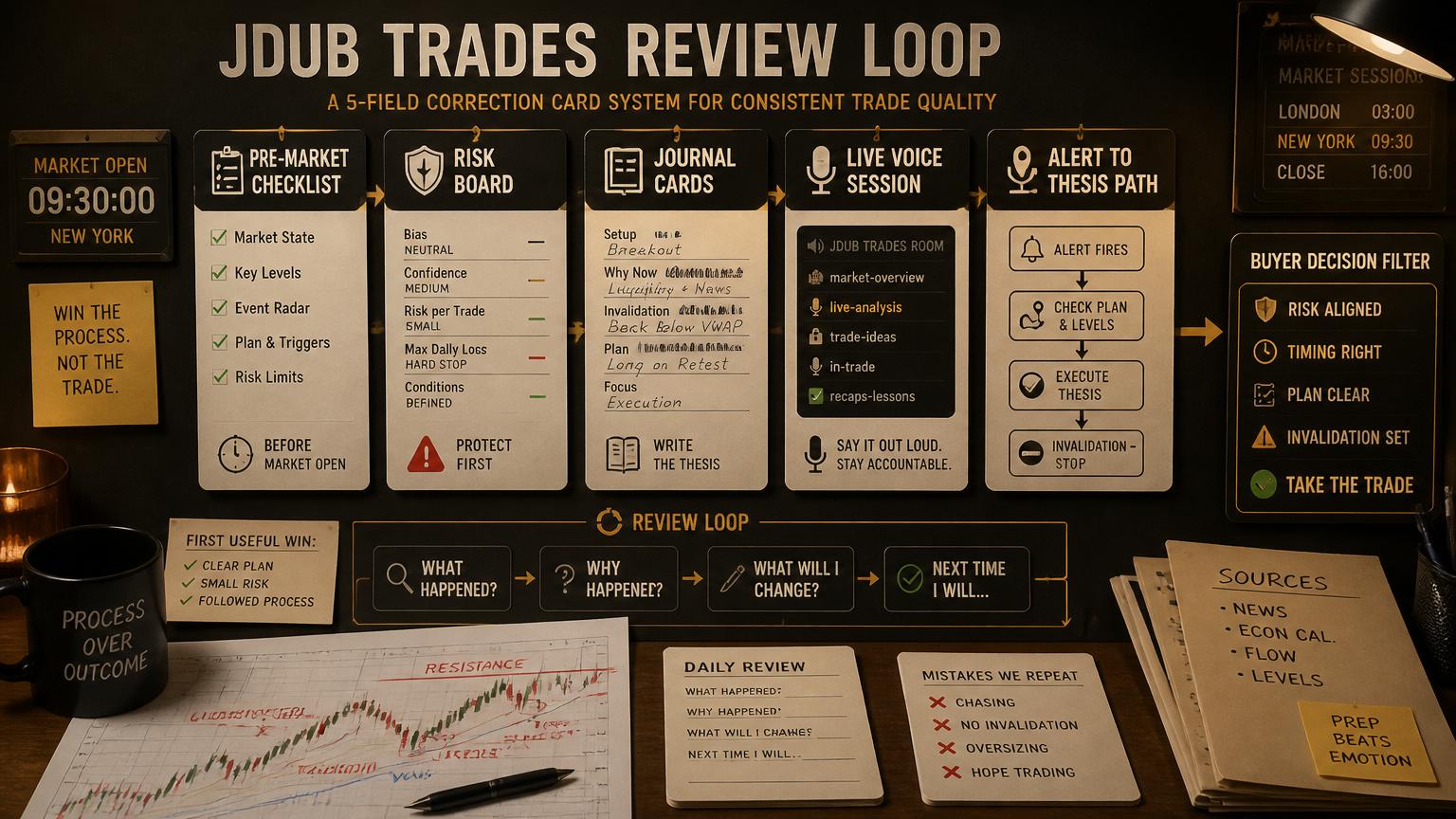
Market-day operating loop

1

Pre-market

Build the map

Mark major levels, planned tickers, market tone, news risk, and the setups you are allowed to touch.

2

Open

Wait for confirmation

The first candle is not a command. Use the live room to compare context without letting speed replace judgment.

3

Entry

Define the risk

Before the click, write the invalidation, the stop logic, the target idea, and the reason the trade exists.

4

Management

Protect the plan

Do not let a green candle rewrite the thesis. Do not let a red candle turn a planned loss into a personal insult.

5

Review

Extract the lesson

A trade review is not a courtroom. It is a lab note: what was planned, what happened, what changes next time.

Long-form field guide

Read this like a trader about to spend real money.

01

The real enemy is not a lack of information.

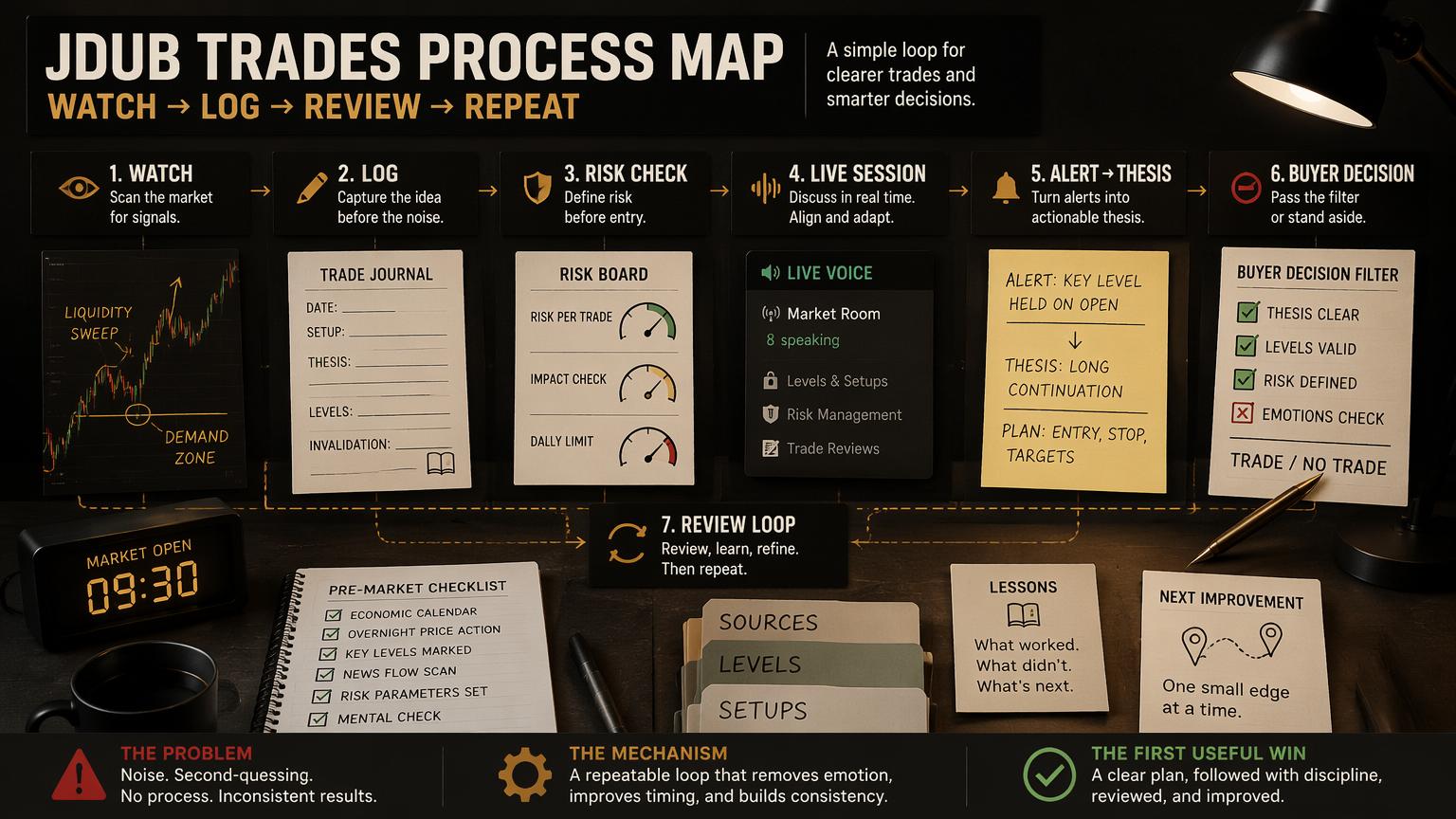
The average trader has more information than any retail trader in history. Charts, news, indicators, Discord rooms, X threads, YouTube breakdowns, options flow, scanners, and economic calendars are all one tab away. Yet the account can still feel like it is being run by impulse. That is the contradiction. More information does not automatically create better decisions. Sometimes it creates a louder room. The trader starts the morning with a loose idea, sees three different opinions, watches price rip through a level, and suddenly the plan is replaced by adrenaline. The problem was never that the trader knew too little. The problem was that nothing forced the knowledge into a process before pressure arrived.
02

A signal without context can become a shortcut to bad habits.

Signals are attractive because they reduce friction. Someone says entry, exit, trim, stop, watch this level, and the messy burden of analysis feels lighter. But that convenience has a sharp edge. If a trader copies without understanding, the alert becomes a rented conviction. The second price moves against them, they do not know whether the setup is invalid or simply breathing. They do not know whether to size down, wait, exit, or avoid the trade completely. That is why the useful version of an alerts community is not just a feed of calls. It is the surrounding explanation: why this chart, why now, what would make it wrong, and how the trade should be reviewed afterward.

03

The first felt result should be clarity, not a profit promise.

A responsible trading page should never sell guaranteed income. Markets do not owe anyone a clean outcome. The first result worth selling is more modest and more useful: clarity. A new member should quickly understand what the room watches, when live sessions happen, how the course is organized, where to ask questions, and how trade reviews work. That clarity matters because confusion is expensive. Confused traders overtrade, oversize, revenge trade, or quit before they have enough reps to learn anything. A clean first week can reduce that fog. It can show the rhythm of the community and give the trader a safer way to participate before they start treating every market move like a test of their intelligence.

04

The story has to go deeper than features.

A feature list says daily live voice, full course, alerts, feedback, and Discord. That is useful, but it is only the top layer. The deeper story is what each feature is trying to fix. Live voice is there because the open moves fast and isolated traders can spiral. The course is there because a trader needs language for what they are seeing. Alerts are there because examples matter, but examples only help when paired with risk. Feedback is there because most people cannot see their own pattern while they are inside it. Community is there because private mistakes repeat until they are named. The offer becomes stronger when every feature is tied to the specific trading failure it is meant to reduce.

05

The right buyer is not looking for a fantasy.

This page should repel the wrong person. If someone wants guaranteed wins, effortless income, or a place to blindly mirror trades with no responsibility, they should leave. That is not a bug. Trading education is a poor fit for anyone who refuses risk, record keeping, and personal judgment. The better buyer is more serious. They may be new, or they may have already been humbled by the market, but they are willing to slow down and learn a process. They want a room where setups are discussed, mistakes can be reviewed, and daily repetition builds a better eye. Strong copy should make that distinction obvious before the click.

06

Price should be compared against the cost of the same mistake repeating.

The wrong price frame is to compare a membership only against another subscription. That makes the decision feel abstract. The more useful frame is the cost of an unchanged trading routine. What does one oversized revenge trade cost? What does one month of random entries teach? What does it cost to keep switching strategies every time a red day appears? That does not mean a membership pays for itself. It means the buyer should evaluate the offer against the cost of continuing without structure. The honest question is simple: would a course, live context, alerts, reviews, and a community help you behave more deliberately than you do now?

07

Proof needs boundaries or it becomes hype.

Trading copy often abuses proof. Screenshots, big numbers, win rates, and dramatic testimonials can create a false sense of certainty. That is dangerous. The cleaner approach is to separate platform facts, member sentiment, educational structure, and outcome claims. If a number is not verified, do not lean on it. If a result is individual, do not imply it is typical. If a member says the room helped them, present that as their experience, not as a forecast for the next person. Strong proof does not need to pretend risk disappeared. In finance, trust increases when the copy admits the boundary of what can be known.

08

The call to action should feel like the next small step.

The page should not end by screaming. The better CTA is staged. First, read the room. Then check the free community if available. Then decide whether Premium fits your goals, schedule, risk tolerance, and learning style. That is environment design, not pressure. A serious trader should not be pushed into a financial education product by fake urgency. They should be given a clear path, a clean summary, a risk reminder, and one obvious next action. If the page has done its job, the button is not a trick. It is simply the next step for the person who recognizes the problem and wants structure around it.

Think

Turn the trade from a feeling into a thesis.

Execute

Enter only when the setup, size, and invalidation are already named.

Review

Bring the trade back to the room so the lesson survives the day.

Responsible next step

Join because you want structure, not because you want certainty the market cannot give.

If you want live context, a course, community discussion, alerts to study, and a place to review your thinking, Jdub Trades may fit. If you want guaranteed income, skip it. The market does not owe certainty. The offer is a structured room for traders who want to become more deliberate.

View Jdub Trades

Conversion atlas

More ways to decide before you click.

This section turns the sales argument into usable objects: maps, matrices, proof ledgers, friction charts, and buyer filters. The page should keep asking the same honest question from different angles: will this room make your trading process less random?

Scenario matrix

If

If you enter late

Then

Pause. Write why the clean entry was missed.

Rule

No chase entry without a fresh thesis.

If

If the alert moves fast

Then

Translate it into setup, invalidation, size, exit.

Rule

No copied conviction.

If

If the first trade loses

Then

Log whether the plan failed or execution failed.

Rule

No revenge trade.

If

If the room gets noisy

Then

Return to the pre-market map.

Rule

No extra ticker because of pressure.

Friction chart

Random watchlist84
No invalidation76
Oversized trade68
Late entry61
Reviewed plan28

Illustrative friction scores. Not a performance metric. The goal is to move from pressure to process.

Decision checkpoint

If the matrix describes your current trading day, inspect the offer now.

The click should come after the rule, not before it.

Open Whop

Before the open

Mark levels, no-trade conditions, risk limits, and the exact setup you are allowed to touch.

During live voice

Listen for context. Track why the read changed. Do not let speed become permission.

After the session

Write the decision, result, behavior, and correction. A room that never becomes a journal leaks value.

Proof ledger

Course

Language

Can you explain the setup without repeating someone else's words?

Live voice

Context

Can you name what changed from plan to open?

Alerts

Examples

Can you convert the idea into risk first?

Reviews

Correction

Can you identify one behavior to adjust tomorrow?

Discord

Accountability

Can the community see the rule before the trade?

Risk ladder

01

Know the product

02

Know the setup

03

Know the stop

04

Know the size

05

Know when not to trade

Decision checkpoint

If you want examples plus review, not certainty, this is the right next click.

Jdub Trades is strongest when used as a repeatable education loop.

Open Whop

Buying for certainty

Bad fit

Needs the market to behave.

Buying for structure

Strong fit

Uses the room to prepare and review.

Copying alerts

Weak use

Breaks when management requires judgment.

Studying alerts

Strong use

Turns examples into a repeatable checklist.

Final filter before the Whop page

Join only if you can name the process you want improved this week: pre-market prep, live-room learning, alert translation, risk definition, or trade review.

Decide with structure

Everything You Need to Trade with Confidence

A complete trading ecosystem - education, live coaching, alerts, and community.

Full Trading Course

A comprehensive A-to-Z curriculum covering strategy, psychology, risk management, and execution. Learn at your own pace.

Daily Live Voice Sessions

Trade alongside Jdub & Tony every market day from 9:30 AM to 11:00 AM EST. Real-time analysis as the market unfolds.

Real-Time Entry & Exit Alerts

Get precise trade signals so you know exactly when to get in and when to get out.

Weekly Market Outlook

Review past week performance and preview upcoming market trends and setups every week.

Personalized Trade Reviews

Submit your trades and get detailed feedback on your decision logic, emotional discipline, and risk.

24/7 Discord Community

Pre-market planning, trade discussions, chart requests, and peer support from thousands of active traders.

Visual operating system

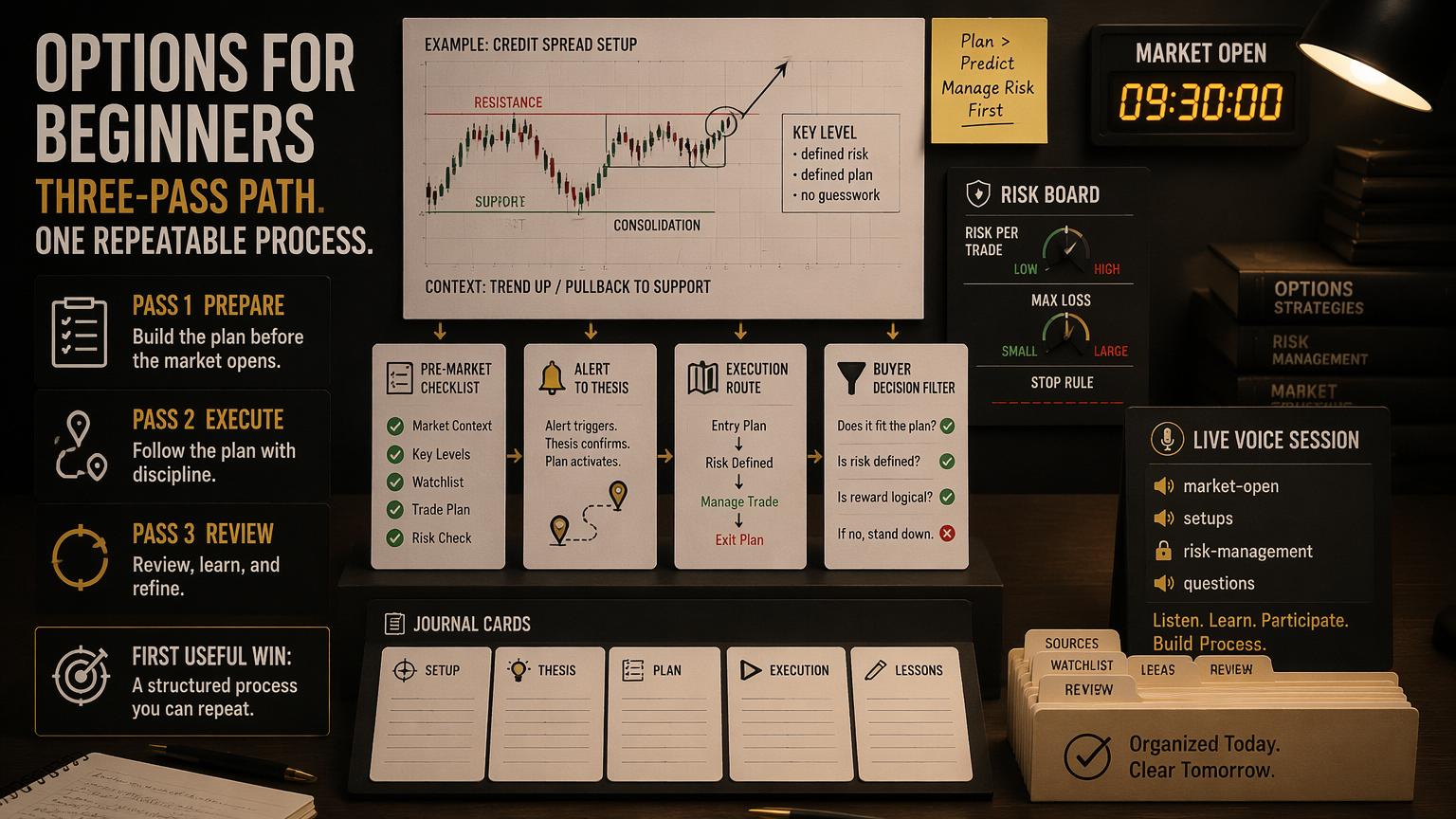
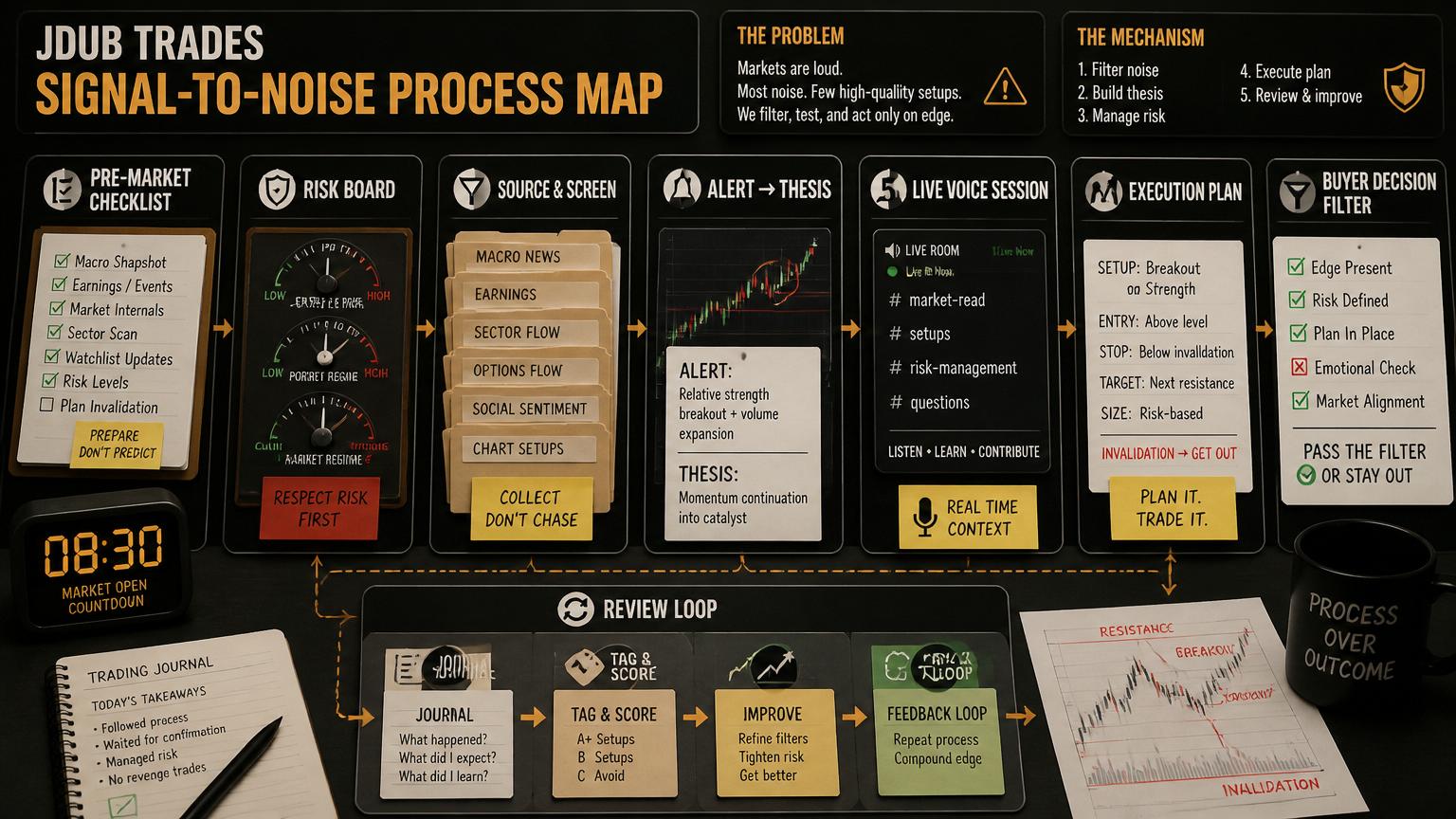
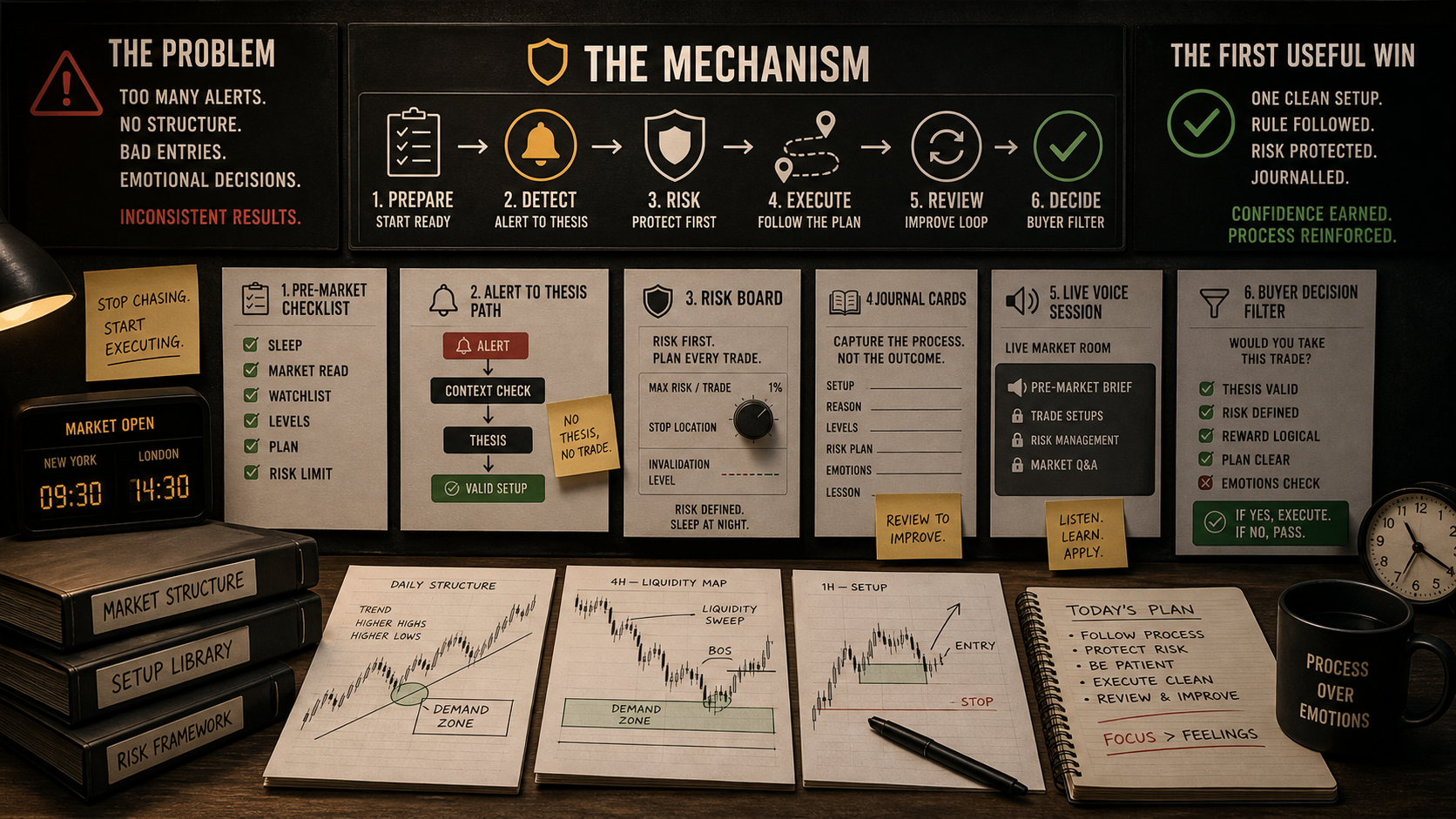
More than lessons. A set of visual checks for the moments traders usually rush.

These generated process boards break the offer into the actual workflow: prepare before the open, execute with risk named, and review while the mistake is still fresh. It gives the page more visual rhythm and gives buyers a cleaner picture of what they are joining.

01

Filter first

No setup is touched until the trader has a level, invalidation, and reason for size.

02

Trade second

Live voice and alerts create context. They are not a permission slip to abandon your plan.

03

Review third

The room becomes valuable when your mistakes are named clearly enough to stop repeating.

04

Compound clarity

The edge is less chaos, fewer impulse clicks, and a tighter post-market correction loop.

Want the full room, course, alerts, and review workflow in one place?

Join Jdub Trades
Featured Program

The Accelerator

Learn to Trade from A to Z

The structured education program inside Jdub Trades that takes you from beginner to consistently profitable trader. It's not just a course - it's a full mentorship experience.

Start the Accelerator

What You'll Master

Market fundamentals & terminology
Trade setups, entries & exits
Risk management strategies
Trading psychology & discipline
Building your own trading edge
Combined with live sessions & reviews
Process Over Hype

The Proof Is In The Process

A trading room is only useful if it helps you think before the click, manage risk during the trade, and review the decision after.

9:30

Live market open

Daily voice sessions during the highest-pressure part of the trading day

A-Z

Course structure

Lessons for strategy, psychology, risk, entries, exits, and review

24/7

Community access

Discord discussion for planning, questions, watchlists, and recap

1:1

Trade review

Feedback loop for decision logic, sizing, emotion, and execution

Recent Shared Trades

Decision checklist
Pre-market map
Planned
Entry thesis
Defined
Invalidation level
Named
Position sizing
Checked
Post-trade review
Logged

This is education and community support, not financial advice. Trading involves risk and results vary.

Your Path to Profitable Trading

01

Learn the Framework

Access the full course and Accelerator modules. Study strategy, risk management, and psychology at your own pace.

02

Trade Live Every Day

Join Jdub & Tony's live voice sessions from 9:30-11:00 AM EST. Follow real-time alerts. Trade alongside experienced mentors.

03

Get Personal Feedback

Submit your trades for detailed review. Get honest, actionable feedback on your decision-making, emotions, and execution.

A Day Inside Jdub Trades

Your Daily Edge, Mapped Out

From pre-market prep to after-hours community - here's what a typical trading day looks like as a Jdub Trades member.

8:00 AM

Pre-Market Prep

Market overview, key levels, and watchlist dropped in Discord before the bell rings.

9:30 AM

Live Trading Session

Join the live voice channel. Real-time callouts, entries, exits, and market analysis.

11:00 AM

Trade Recap

Breakdown of every trade taken - what worked, what didn't, and why. Full transparency.

Afternoon

Education & Course Work

Dive into the Accelerator modules, study setups, and sharpen your skills at your own pace.

Evening

Trade Reviews & Feedback

Submit your trades and get personalized feedback from Jdub & Tony on your execution.

After Hours

Community & Chill

Chat with fellow traders, share ideas, ask questions. The community never sleeps.

Jdub Trades Plans on Whop

Prices as listed on Whop. Links are affiliate links.

Free Community

Free

Get a taste of the community and free content

Access free content
Community chat
Watch free market analysis
Decide if Premium is right for you
Join Free

Monthly

$200/month

Test the waters and experience everything

Full trading course access
Daily live voice sessions
Real-time entry & exit alerts
Weekly market outlook
Personalized trade reviews
24/7 Discord community
Start Monthly
Best Value

Annual

$997/year

Save over 58% - best value for committed learners

Everything in Monthly
~$83/mo - save over 58%
Full trading course access
Daily live voice sessions
Real-time alerts
Personalized trade reviews
Get Annual Plan
Ultimate

Lifetime

One-Timepayment

Full access forever. The ultimate investment

Everything in Annual
No recurring payments ever
Lifetime updates & access
Full trading course access
All live sessions forever
Priority support
Go Lifetime
4.85 out of 5 / 540 reviews on Whop

What Members Say on Whop

Jdub Trades is rated 4.85 out of 5 from 540 reviews on its Whop page (checked 7 Nov 2026). Read the reviews in full on Whop (affiliate link).

The Difference

This Isn't Another Signal Group

Copy-paste alerts with no context
Live voice sessions explaining the why behind every trade
Pre-recorded generic courses
Personalized trade reviews with direct feedback on your trades
Hype-driven, show off lifestyle
Realistic expectations, discipline-first mentality
"Just follow my signals"
"Learn to fish" - build your own edge and trading identity

Hover to compare - the difference speaks for itself.

Not Ready to Commit? Start Free.

Join the free Jdub Trades community and experience the quality for yourself. Watch free content, interact with members, and see why 14,900+ traders chose this community.

Join Free Community
FAQ

Frequently Asked Questions

Stop Watching from the Sidelines.
Start Trading with an Edge.

14,900+ traders
4.85 rating on Whop
Live coaching every market day

The only question left is - are you ready?